Popular Science Article
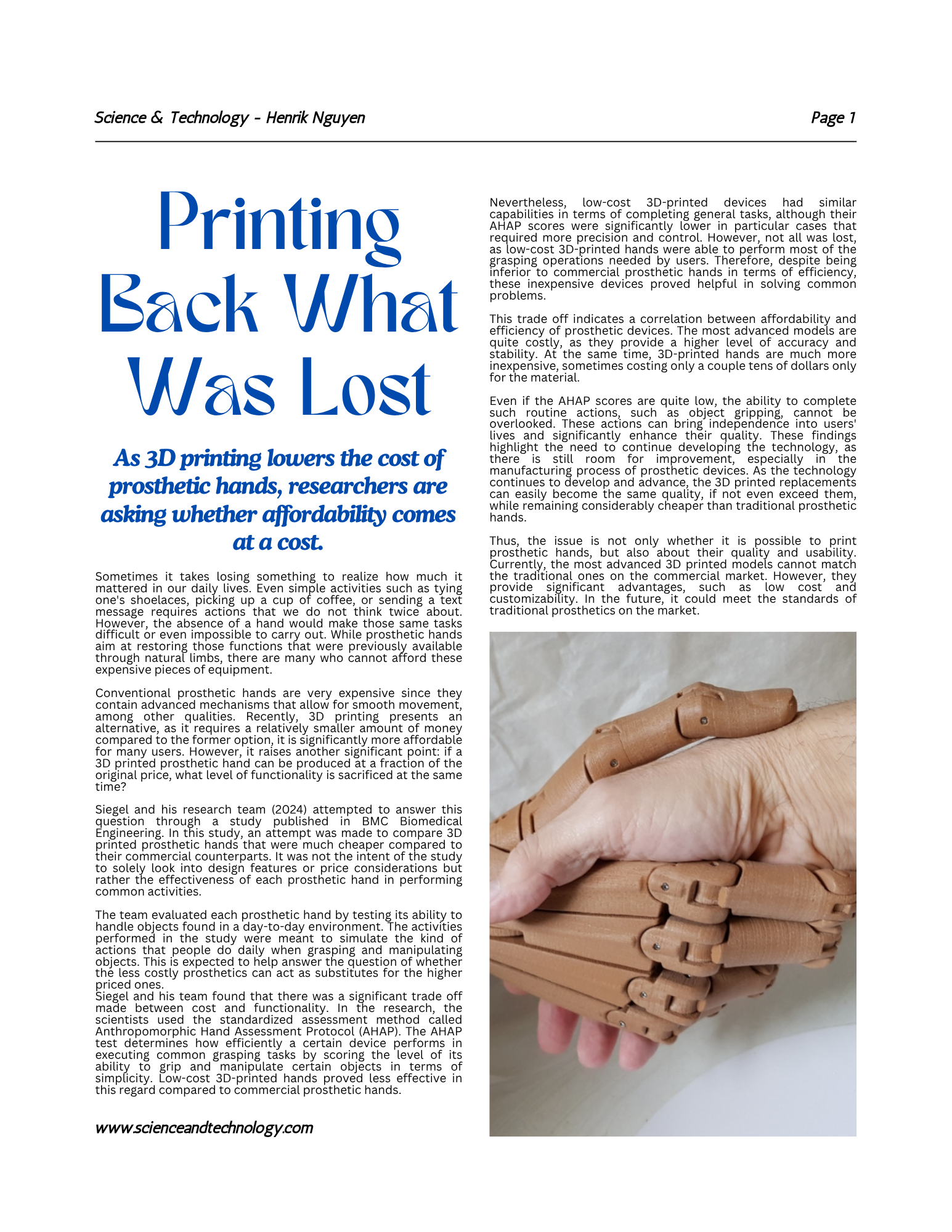
A traditional prosthetic hand can cost several thousand dollars, making it inaccessible for many people across the world who need one. The high price tag has prevented patients of all ages from receiving treatments and solutions that are both accessible and customizable. However, this is all starting to change. With the rise of 3D printing technology, engineers are beginning to explore the possibilities of creating prosthetic devices that are much more affordable and customizable to a patient's specific needs.
Throughout this website, we will analyze and discover the effectiveness of 3D printed prosthetic devices. The potential that this technology has for innovation is massive, but it is necessary to consider the results of many different test trials and then evaluate their performance. There are several experiments examining the efficacy of various prosthetic models in terms of grip strength, utility, and usability. These results will show the benefits and drawbacks of 3D-printing technologies and how it is still growing.
This site includes a synthesis that comprises the review of several research articles devoted to 3D printing of prosthetic devices, along with a popular science article written for general readers. Together, this work will provide a technical and general overview of how 3D printed prosthetic devices are being developed and evaluated.

Hello! My name is Henrik Nguyen and I am a junior majoring in Mechanical Engineering at CU Boulder. I love doing hands on work combined with CAD designing to go from ideas into physical builds. I am interested in applying the things that I learn into real world engineering and would like to have a career in aerospace, defense, or robotics after I graduate.
Engineering has always been a passion of mine since my early school years because I loved to take apart things and explore the way they work. I like solving problems and understanding how things work so engineering just felt right for me. My CAD class in high school was what really widened the doors for me. Being able to design something and then use the designs and drawings to create something physical was almost like magic for me, especially with 3D printing technology that came out that year too. I was certain that I wanted to continue designing and making anything and everything.
After much consideration, I have decided to pursue a masters degree in Mechanical Engineering with focus on robotics. Therefore I found 3D printed prosthetics very closely related and with my family’s background in the medical field, it just felt right. I enjoy working on robotics and want to continue improving my ability to design for real world function and applications. Prosthetic devices take these complex engineering systems and apply them to solve basic human problems. The ability for this technology to restore someone’s quality of life is truly beautiful, and is a big reason why I chose to explore and learn more about this technology. So please come along my journey and learn more about 3D printing.
Researchers have focused on the affordability and accessibility of 3D printed prosthetics as an alternative to traditional devices. 3D printing allows for significantly lower production costs while also enabling easier customization for individual users.
Affordability, prototypability, and accessibility are very important as 3D printing is typically a cheaper alternative to traditional prosthetic devices. Lee et al. report that “the cost of the 3D-printed finger prosthesis in this study was very low (approximately $30) compared to the cost of a commercially body-powered prosthetic finger, which can range from $4000 to $10,000” (Lee et al., 2022, p. 5). This drastic cost difference shows how much more affordable 3D printing is especially in resource limited contexts. In fact, the entire process can cost “as low as $19 USD in raw materials and parts” compared to “commercially available devices that can cost upwards of $20,000 USD” (Siegel et al., 2024, p. 2). It is clear that 3D printed prosthetics are much more affordable than their traditional counterparts not through just single uses but many uses as well.
Beyond affordability, researchers have also emphasized how these cost advantages directly contribute to increased accessibility through rapid prototyping and design flexibility. Gómez-Amador et al. report that the difference in infill geometry, material selection, and print parameters can all be adjusted without expensive tooling, which allows for rapid prototyping and low cost iteration during design processes (Gómez-Amador et al., 2025). The ability to quickly modify and reproduce designs makes 3D printed prosthetics more accessible to a wider range of users and applications all at a cheaper cost than traditional prosthetics. Patients all around the world can have multiple iterations and devices for specific uses that are not only more affordable, but more flexible for certain situations. As this technology continues to develop, 3D printed prosthetics have the potential to greatly expand access to affordable prosthetic care for users around the world.
Gómez-Amador, A. M., Pérez-Carrera, C., Prieto-Fernández, L., & Rubio-Alonso, H. (2025). 3D-printed prosthetic foot design: Mechanical similarity and testing. Materials & Design, 253, 113918. https://doi.org/10.1016/j.matdes.2025.113918
Lee, M.-Y., Lee, S. H., Leigh, J.-H., Nam, H. S., Hwang, E. Y., Lee, J. Y., Han, S., & Lee, G. (2022). Functional improvement by body-powered 3D-printed prosthesis in patients with finger amputation. Medicine, 101(25). https://doi.org/10.1097/md.0000000000029182
Siegel, J. R., Harwood, J. K., Lau, A. C., Brenneis, D. J., Dawson, M. R., Pilarski, P. M., & Schofield, J. S. (2024). A performance evaluation of commercially available and 3D-printable prosthetic hands. BMC Biomedical Engineering, 6(1). https://doi.org/10.1186/s42490-024-00086-w